
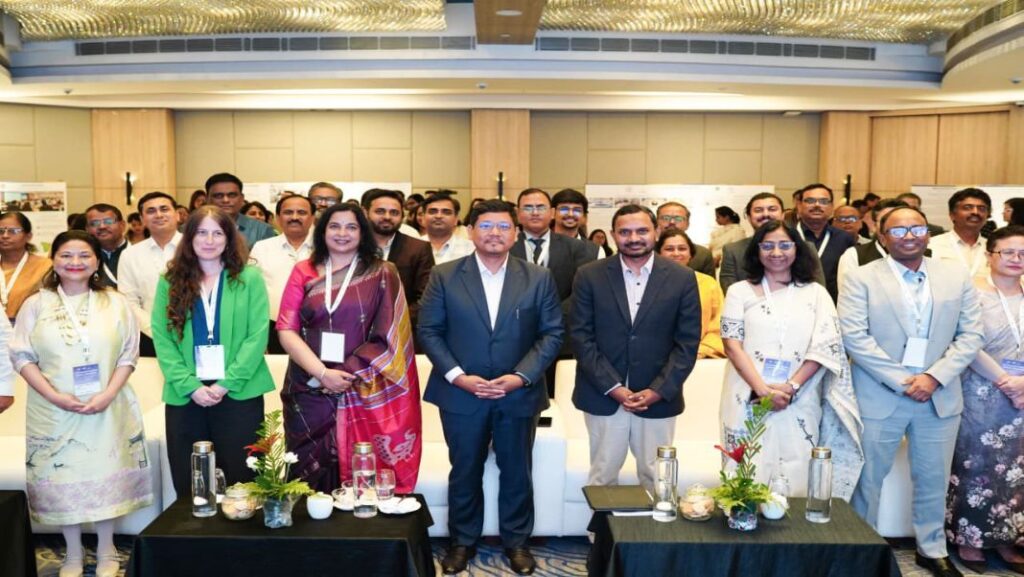
SHILLONG, JUNE 1: Chief Minister Conrad K Sangma on Monday inaugurated the three-day Early Childhood Development Implementation Science Workshop at Vivanta, Shillong, stressing that “meaningful change does not always require new schemes or policies, but rather better implementation of existing ones.”
Had the opportunity to inaugurate the ECD Implementation Science Workshop in Shillong, bringing together experts, policymakers, and partners to strengthen how we support our children and families.
Early childhood development is not one department’s responsibility, it is about… pic.twitter.com/ur412G9aA5
— Conrad K Sangma (@SangmaConrad) June 1, 2026
Organised under the Meghalaya Early Childhood Development Mission with the State Capability Enhancement Project, Van Leer Foundation, and Asian Development Bank, the workshop theme is “From Science to State Action — Building Integrated Systems for Early Childhood Development.”
Recalling his start as Chief Minister in 2018, Sangma said he drew from author Shiv Khera. “I would not do anything different, but would do things differently.”
He said both Central and State schemes are largely designed to address existing developmental challenges and that the real challenge often lies in implementation.
Better execution, he noted, had led to a nearly threefold increase in MGNREGA utilisation and a “four- to five-fold increase” in centrally sponsored schemes.
Meghalaya is now implementing “nearly ₹12,000 crore worth of externally aided projects, exceeding the portfolio of many other small states.”
On leadership, Sangma said, “We often know the problems. We understand the science, the data and the analysis behind them. But ultimately, there has to be a will to make a difference.”
The role of leadership, he added, is “to identify capable individuals, place them in positions where they can contribute effectively, and provide them with the confidence and support needed to perform.” Governments, he said, “do not always need entirely new ideas but rather a stronger capacity to implement existing ideas effectively.”
Citing maternal mortality, Sangma said the state first assumed “increasing institutional deliveries would solve the problem,” but analysis showed “the real barriers were economic and logistical in nature, including transportation costs, distance, and the lack of support systems for expectant mothers.”
“We were encouraging institutional deliveries without recognising the economic realities these mothers faced,” he said.
Instead of buying more ambulances, the government used local vehicle owners for transport and set up Safe Motherhood Homes.
“The lesson here is that we must identify where the actual problem lies and then design solutions that are practical, affordable and tailored to local realities,” he said.
He emphasized outcomes over outputs. “The completion of infrastructure projects alone should not be regarded as success.”
On the new ₹160-crore indoor stadium, he said “the true measure of success would be reflected in the achievements of young athletes and the positive impact sports have on their lives.”
On irrigation, he recalled telling an engineer, “I told him that he was mistaken. The true measure of success is how much agricultural production increases because of those canals. The canal itself is not the objective; improving people’s lives is.” This led to the MOTHER programme — Meghalaya’s Outcome and Transformation in Health, Education, Rural Development and Social Benefit.
“We are no longer looking at departments or schemes in isolation. We are looking at a human life and asking how government can support that life at every stage,” he said.
Linking health to economics, he said many young mothers had frequent pregnancies “because of limited economic opportunities and financial independence.” Self-Help Groups grew from “approximately 4,500 to nearly 60,000” in eight years.
On cooperative federalism, Sangma said, “There are no small states or big states when it comes to innovation and good governance.” He noted Meghalaya learned from Odisha, Maharashtra, Andhra Pradesh, and Sikkim.
“That is the true spirit of cooperative federalism—not only cooperation between the Centre and the States, but cooperation among States themselves,” he said. He called the workshop an opportunity “to exchange ideas, strengthen partnerships, and deepen understanding of the diverse experiences of different regions.”
The goal, he said, is “to ensure that every child reaches his or her full potential, that no mother loses her life unnecessarily, and that every citizen receives the support needed to live a meaningful and dignified life.”
The workshop also featured Chile’s “Chile Crece Contigo” model, presented by Patricia Núñez Zamora of the Van Leer Foundation, and remarks from Van Leer Country Head Prakash Kumar Paul and Additional Chief Secretary Sampath Kumar on Meghalaya’s integrated ECD approach.