
Shillong, Aug 16: From the warrior dance of the Khasi hills to the harvest dance of the Garo community and folk traditions from Jammu and Kashmir, Rajasthan and Bengal, Meghalaya’s Lok Bhavan turned into a vibrant showcase of India’s cultural diversity on the 80th Independence Day.
Governor C. H. Vijayashankar hosted the traditional “At Home” reception at Lok Bhavan, Shillong, bringing together Chief Minister Conrad K. Sangma, senior government officials, defence and police personnel, artists, cultural representatives and other distinguished guests.
Themed “Colors of India”, the reception featured a cultural programme curated by the Governor’s Secretariat in collaboration with the Department of Arts & Culture, offering a colourful journey across India’s diverse traditions.
The programme opened with the Governor inaugurating stalls and displays featuring farmers, entrepreneurs and artists on the Lok Bhavan lawns.
The cultural showcase included Jogari, Jagarna and Rouf dances from Jammu and Kashmir; Bhawai and Kalbelia performances from Rajasthan; a musical presentation by Karnataka Sangha, Mandya; and Bengal’s vibrant cultural traditions.
Meghalaya’s own heritage took centre stage with Ka Shad Mastieh, the traditional warrior dance of the Khasi tribe, Wangala, the harvest dance of the Garo community, and Chad Kheit Soh, a traditional folk dance of the Jaintia tribe.
A Bharatanatyam presentation of Vande Mataram by Prajna Kashyap from Mysore added another dimension to the programme, while the Assam Rifles and Assam Regimental Centre bands brought the celebrations to a stirring musical close.
Grassroots achievers honoured
The reception also recognised three grassroots achievers for their contributions to traditional skills and culture.
Lynti Rynghang of Ri Bhoi was felicitated for woodcraft, Norma R. Lakiang of East Khasi Hills for bonsai, and Dirot Chambugong Marak of West Garo Hills for traditional musical instruments.
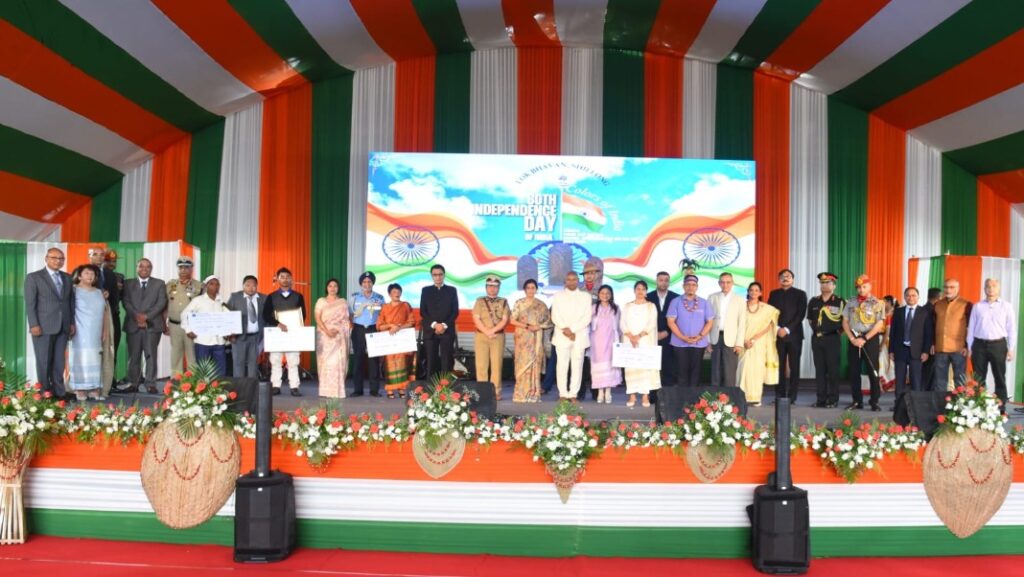
Winners of the Flower Show, including the King of Flower Show, Queen of Flower Show and Best Stall, were also felicitated.
From Raj Bhavan to Lok Bhavan
The celebrations carried a significance beyond the Independence Day festivities.
Following the cultural programme, Lok Bhavan was opened to the public, allowing thousands of citizens to enter the premises, explore the historic complex and browse stalls showcasing local products and the work of entrepreneurs.
The opening of the premises to the public underscored the larger idea behind the transformation of Raj Bhavan into Lok Bhavan—from a traditional symbol of the ruler’s residence to a “house of the people”.
On the 80th Independence Day, that idea took a tangible form as citizens were welcomed into the premises to experience its heritage, culture and public spaces.
The “At Home” reception thus brought together patriotism, India’s cultural diversity and Meghalaya’s grassroots talent, while reinforcing the message that Lok Bhavan is intended to be an open and inclusive institution belonging to the people.