
Guwahati, Jan 18: Prime Minister Narendra Modi on Sunday performed the Bhoomi Pujan of the ₹6,950-crore Kaziranga Elevated Corridor project, a landmark infrastructure initiative aimed at easing traffic while safeguarding wildlife movement through the UNESCO World Heritage Site.
Calling Kaziranga “the soul of Assam and a priceless jewel of India’s biodiversity,” the Prime Minister said the project reflects India’s commitment to balancing economic growth with environmental protection. For long, it was believed that nature and progress could not move together. Today, India is showing the world that both can advance side by side,” he said at Kaliabor.
The 86-km project involves four-laning of the Kaliabor–Numaligarh stretch of NH-715 and includes a 35-km elevated wildlife corridor designed to allow uninterrupted movement of rhinos, elephants and tigers beneath the roadway, especially during floods. Vehicles will pass above the forest landscape, significantly reducing animal casualties and human-wildlife conflict.
The Cabinet Committee on Economic Affairs (CCEA) has already approved the widening and improvement of the Kalibor–Numaligarh section of NH-715 into a four-lane corridor, incorporating extensive wildlife-friendly measures across the Kaziranga stretch.
The ambitious project will be executed under the Engineering, Procurement and Construction (EPC) mode, covering a total length of 85.675 km at an estimated capital cost of ₹6,957 crore, making it one of the most ecologically sensitive highway upgrades undertaken in India.
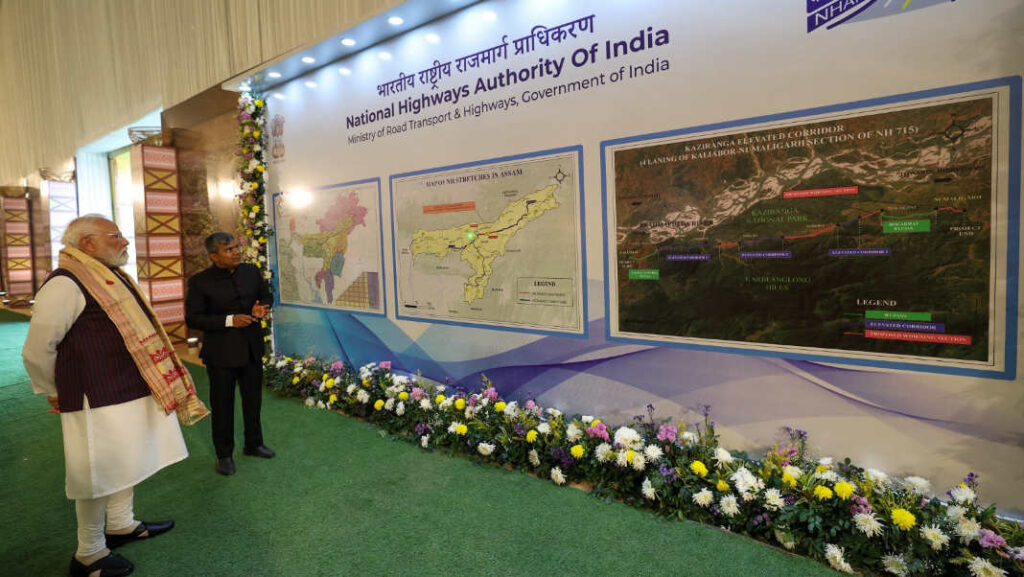
Unlike conventional underpasses or culverts, the elevated structure keeps the entire ground below accessible, allowing animals to move naturally along broad fronts rather than funnelling them into narrow crossings. Given Kaziranga’s scale of seasonal movement and diversity of species, officials describe it as a corridor likely to be used by a wide range of wildlife, making it one of the most intensively utilised animal passages in the country.
The corridor will pass through Nagaon, Karbi Anglong and Golaghat districts, improving connectivity to Upper Assam, including Dibrugarh and Tinsukia, while also strengthening links with Arunachal Pradesh.
Prime Minister Modi noted that Kaziranga has witnessed a steady rise in tourism in recent years, creating livelihood opportunities for local youth through homestays, guiding services, transport, handicrafts and small enterprises. “When nature is protected, opportunities flourish alongside it,” he said.
He also highlighted Assam’s success in wildlife conservation, pointing out that no rhino poaching incidents were reported in 2025, attributing the achievement to stronger protection measures, modern surveillance and community participation, including the ‘Van Durga’ initiative.
During the programme, the Prime Minister also flagged off two new Amrit Bharat Express trains—Guwahati (Kamakhya)–Rohtak and Dibrugarh–Lucknow (Gomti Nagar)—and announced the launch of the Vande Bharat Sleeper Train connecting Guwahati and Kolkata. He said enhanced rail connectivity would benefit traders, students and passengers while bringing the Northeast closer to the national mainstream.
Modi noted that Assam’s annual railway budget allocation has risen nearly five-fold since 2014, leading to expansion, electrification and capacity enhancement across the region.
Emphasising the Centre’s focus on the region, the Prime Minister said, “The Northeast is no longer distant—neither in terms of development nor in the hearts of the nation. It is now closer to Delhi than ever before.”
He added that Assam’s progress is giving fresh momentum to India’s Act East Policy and opening new avenues for regional growth.
Governor of Assam Lakshman Prasad Acharya, Chief Minister Himanta Biswa Sarma, Union Ministers Sarbananda Sonowal and Pabitra Margherita, along with other dignitaries, were present at the event.