
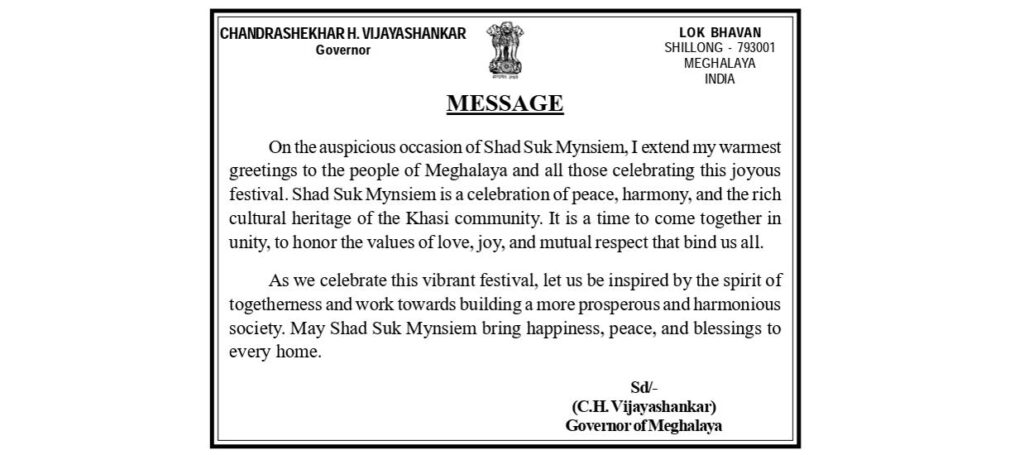
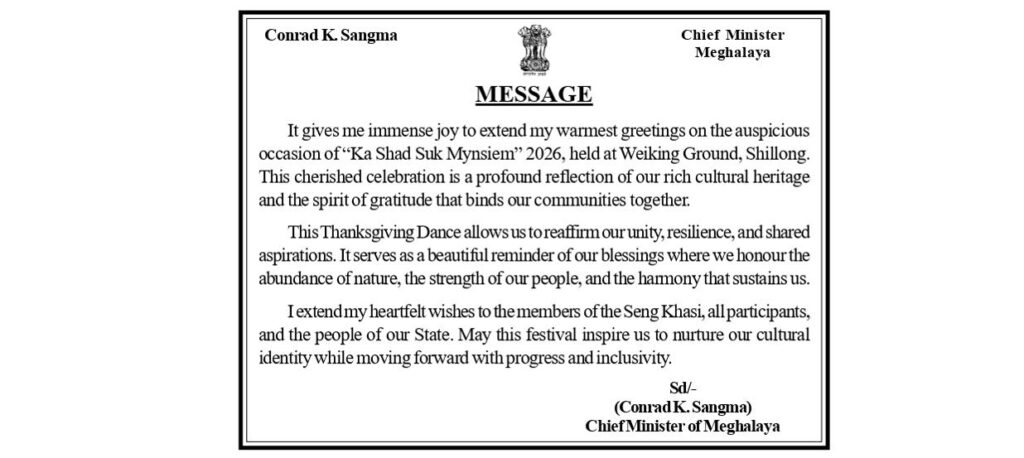
SHILLONG, APR 13: Khasis in the state today celebrated the Shad Suk Mynsiem or the ‘Dance of the Joyful Souls’, an annual thanksgiving festival.
Thousands of spectators including tourists witnessed the colourful traditional thanksgiving dancing festival, held at Weiking Ground, Jaiaw in the city for the past over 100 years.
Organized annually by the Seng Khasi Seng Kmie, the Shad Suk Mynsiem, also known as the ‘Spring Festival’ concluded here on Monday.
Hundreds of people belonging to the ‘Niam Khasi’ including young and old took part in the dancing festival accompanied by the beats of the drums and tangmuri to give thanks to God for all the blessings that he has bestowed.
The Vice President of Seng Khasi Kmie, Rgh PD Nongrum, has emphasized the importance of preserving indigenous culture and traditions, while promoting mutual respect among different faiths, at the Shad Suk Mynsiem festival.
Speaking to reporters, Nongrum said the event, which showcases traditional dances and customs, is part of efforts to promote cultural tourism.
“The government has been very supportive… We are very grateful to the state government for helping us in many ways,” he said.
On youth participation, he expressed pride that “the youth have understood the importance of preserving our own traditions and culture.”
Nongrum noted an increasing number of young participants, including children as young as 5-6 years old, and said, “I am very proud that the youth have understood the importance of preserving our own traditions and culture especially knowing that we can only preserve our distinctiveness of a race through our culture and religion.”
Addressing concerns about minority status, Nongrum said, “Minority is a very relative term… We don’t pay much attention to that; we work towards preserving our culture and we work towards making our youth understand the values of protecting your identity through your customs and through your faith.”
On conversion, he said, “The constitution itself gives you freedom to profess any faith… We are more concerned with sending the message to our own community, to our own youth, that you have your own culture, you have your own customs, you have your own religion… Why should we go and adopt something which is… foreign to us?”
Nongrum stressed, “We are taught to respect others but you love your own. If we can work on this, this simple message that I respect you and you respect me, I hold dear to what I believe and you hold dear to what you believe… we live peacefully.”
He warned against the dangers of believing one’s faith is superior to others, saying, “If you think that your belief is better than mine and mine is better than yours, that is when the trouble starts, that’s when religion will divide.”